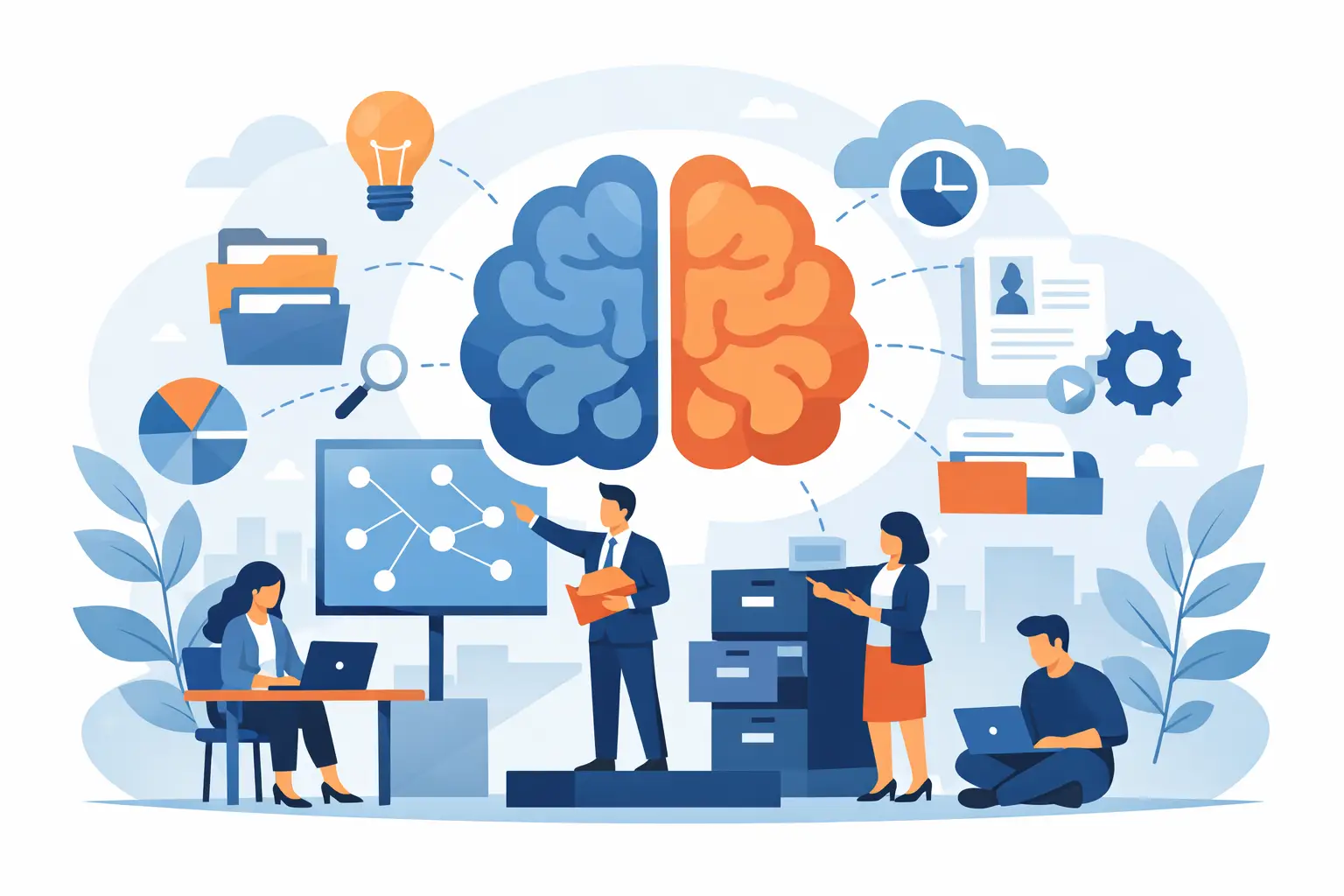
When a critical decision depends on someone who left, changed departments or simply no longer remembers why a certain path was chosen, the problem is not individual. It is structural. Organizational memory in companies exists precisely to prevent context, criteria, learnings and the relationships between initiatives from disappearing in the middle of operations.
In growing organizations, this topic stops being an administrative detail and becomes a factor of operational capacity. Without organizational memory, the company keeps running, but with a growing hidden cost: rework, misalignment between areas, repeated decisions, low predictability and loss of execution speed. The central point is not just to store information. It is to preserve useful context so the organization can decide, coordinate and execute better over time.
What organizational memory in companies is
Organizational memory is not a file repository. Nor is it limited to formal documentation or a knowledge base. In practice, it brings together the company's living history: decisions made, the reasons that supported those decisions, dependencies between areas, learnings from projects, operational patterns, recurring exceptions, identified risks and agreements that shape execution.
This includes explicit elements, such as policies, processes and records, but also components that are harder to capture, such as prioritization criteria, the rationale for changes, the political context between areas and the knowledge accumulated by leaders and specialists. That is why many companies believe they have organized memory when, in fact, they only have scattered information.
The difference is decisive. Isolated information does not generate continuity. Organizational memory generates the capacity to resume, interpret and act.
Why context loss is so costly
Every company creates knowledge while it operates. The problem is that much of this knowledge stays distributed across conversations, presentations, disconnected apps, spreadsheets, emails and in the heads of a few people. While the structure is simple, this improvised model may seem sufficient. When complexity increases, it begins to fail.
Context loss directly affects governance. Initiatives proceed without clarity about origin, justification or dependencies. Areas make decisions based on different versions of the same reality. New managers take on responsibilities without access to the history that explains current priorities. Instead of continuity, the organization starts operating through constant reconstruction.
This scenario produces a cumulative effect. With every change of team, internal reorganization or new strategic front, part of the company has to relearn what had already been learned. The cost appears in delays, friction between areas, contradictory decisions and the inability to scale execution with consistency.
Organizational memory is not just documentation
A common mistake is to treat the topic as a documentation initiative. Documenting is necessary, but it does not solve the problem on its own. Often the company records processes and policies, but does not connect those records to decisions, to projects, to owners and to operational developments.
In practice, organizational memory needs to answer questions that traditional documentation rarely answers well. Why was this process designed this way? What risk motivated this rule? Which area decided to change the priority? What has been tried before and why did it not work? Without this layer of context, the document becomes a static file and quickly loses value.
That is why more mature companies start treating memory as operational infrastructure, not as an archive. The goal stops being to store content and becomes to sustain coordination, continuity and decision quality.
Where organizational memory is lost
In general, the loss does not happen through negligence. It happens because operations grow on fragmented structures. Each area adopts its own tools, its own rituals and its own logic of recording. Knowledge starts to circulate, but not to remain in a connected way.
It is common to find strategic decisions recorded in minutes, execution tracked in another system, learnings discussed in meetings, risks mapped in spreadsheets and scope changes communicated by message. None of these elements, in isolation, is wrong. The problem lies in the lack of continuity between them.
When context fragments, the company loses traceability. It knows what is happening in parts of the operation, but cannot easily reconstruct how it got there. In environments with multiple initiatives, interdependent areas and constant transformation, this limitation compromises the capacity for governance.
How to structure organizational memory in companies
The most effective path starts with a change in logic. Instead of asking where to store documents, the more useful question is: what context needs to persist so the organization keeps operating with quality, even in the face of change?
This usually requires mapping a few central axes. Relevant decisions need a record of rationale, owners, expected impact and adopted criteria. Strategic initiatives need to be connected to objectives, dependencies, risks and milestones of evolution. Critical processes need to reflect not only the ideal flow, but also recurring exceptions and operational learnings.
It is also important to recognize that not all information deserves the same level of persistence. There is a clear trade-off between depth of recording and operational viability. If the capture requirement is excessive, the system does not hold up. If it is too superficial, the memory does not serve when it matters most. The balance point varies according to the company's degree of complexity, the criticality of the initiatives and the level of governance required.
The relationship between memory, execution and predictability
Companies do not lose performance only for lack of effort. Many lose it for lack of continuity between intention and execution. When organizational context is lost, strategy no longer has a clear line of operational translation.
Organizational memory reduces this mismatch because it keeps visible the connections between decision, priority, owners, history and result. This improves the quality of handoffs between areas, accelerates the onboarding of leaders, reduces disputes based on incomplete interpretations and increases the ability to identify deviations before they become a structural problem.
Predictability does not arise only from metrics. It depends on accumulated context. A predictable organization is one that can understand the present in light of what has already happened, rather than merely reacting to what shows up on the screen this week.
The role of technology in this process
Isolated tools help record parts of operations, but they rarely solve the challenge of organizational memory in companies completely. The reason is simple: useful memory is not just in the stored content, but in the relationships between decisions, people, processes, initiatives and operational signals.
That is why the most valuable technology in this context is the one that creates contextual continuity. It not only stores information, but organizes links, history, governance and traceability over time. This kind of structure allows the company to consult fewer fragments and access more understanding.
In companies with accelerated growth or ongoing operational transformation, this point becomes even more relevant. The greater the dependence on coordination between areas and systems, the lower the tolerance for scattered knowledge. This is where organizational intelligence platforms, such as FrameOn, gain relevance: not as another management layer, but as infrastructure to preserve context and sustain execution with continuity.
Signs that the company already feels this problem
The topic does not always appear under the right name. A leader rarely says the company suffers from insufficient organizational memory. What appears are symptoms: decisions reopened frequently, meetings to recover context, excessive dependence on key people, difficulty understanding the origin of priorities and a constant feeling that operations are always starting over.
Another common sign is low confidence in the available information. The data exists, the records exist, but no one is sure which version represents the real context. When this happens, the organization does not just suffer from disorganization. It loses coordination capacity.
Organizational maturity requires persistent memory
As the company grows, informality stops being agility and becomes risk. The knowledge that once circulated naturally among a few people needs to gain persistence, connection and governance. This move does not mean bureaucratizing operations. It means creating conditions for the company to keep learning without depending on continuous reconstruction.
Mature organizational memory does not make things rigid. It reduces unnecessary friction, improves transitions and preserves accumulated intelligence. In complex environments, this represents a concrete operational advantage.
The most strategic question is not whether your company already produces enough knowledge. It certainly does. The question is whether that knowledge remains accessible, connected and usable when operations change. That is when memory stops being an archive and becomes a real capacity for delivery.