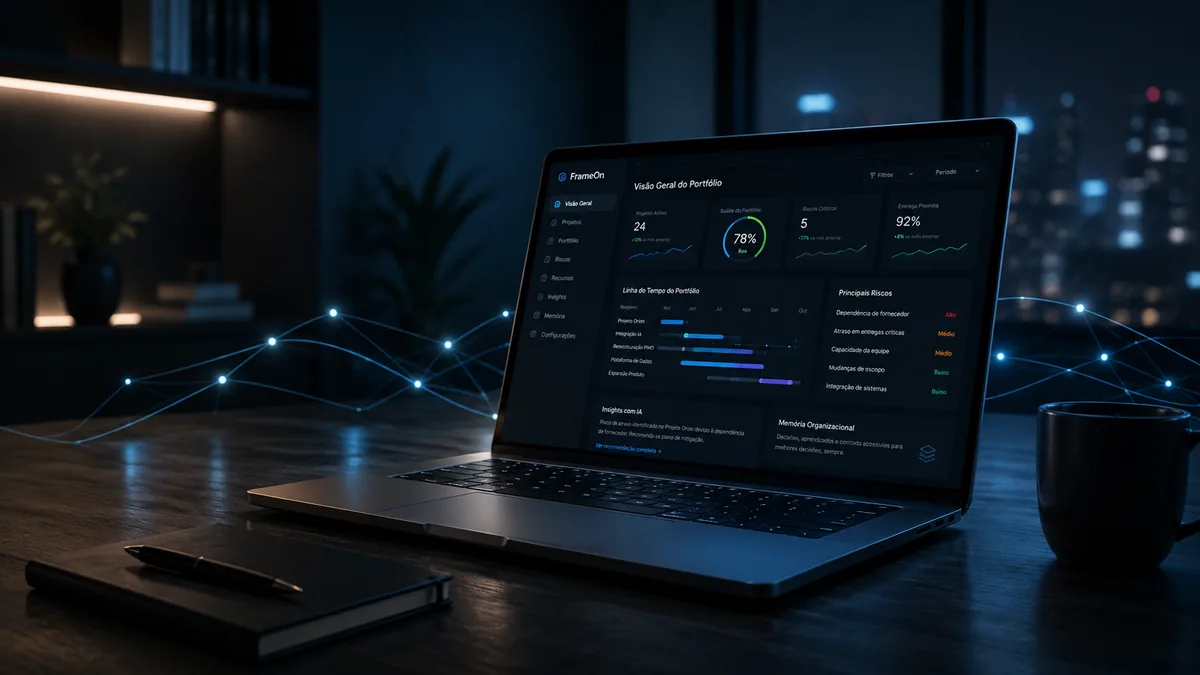
Project Management with Artificial Intelligence is evolving fast. Agentic Project Management represents an architecture capable of continuously tracking execution, anticipating risks and preserving organizational context.
1. The turning point in project management
In recent years, Project Management with Artificial Intelligence has gained traction in the market through copilots, writing assistants and point automations that support company routines. However, no matter how much these tools have evolved from traditional platforms — such as Jira, Asana, Monday.com and ClickUp — they have kept one premise intact: they are still designed as passive repositories to record work done by people.
The software stores history, but keeps depending on the manager to interpret context, anticipate risks and coordinate execution. It is the project manager, PMO or Tech Lead who has to interpret meetings, translate decisions into tasks, monitor deadlines, spot invisible risks and put together reports for the board.
The tool remains blind to context and inert to risks. This logic worked when projects depended on periodic manual checks. However, the demands on delivery tracking have raised the bar, consolidating Agentic Project Management as a new architecture for the market.
2. The arrival of AI agents and the tracking model
Artificial intelligence has moved from simple writing assistants to AI agents capable of tracking a project's context, interpreting data from multiple sources and assessing initiative health in real time.
An important clarification: the role of these agents is not to replace professionals by creating "virtual executors" to perform every technical task. Instead of acting as isolated task executors, agents operate as continuous guardians of the project. In Agentic Project Management, the focus is on orchestrating governance, continuously monitoring delivery health, anticipating bottlenecks and triggering intelligent alerts for everyone involved in the project.
Technical Definition: Agentic Project Management is a specific architecture within Project Management with Artificial Intelligence, built from the ground up for the era of agent-based artificial intelligence. It connects AI agents to the company's entire history and context to continuously track delivery health, anticipate risks before they affect the schedule and support project governance in real time.
More than adding AI to project management, this category changes who continuously tracks execution: part of that work stops depending exclusively on the manager and becomes shared with specialized agents.
In a next-generation AI project management software, the system stops waiting for the human to update status and starts acting in a preventive and continuous way.
3. The limitation of the legacy data architecture
Legacy platforms have been incorporating advanced AI features, such as meeting summaries and conversational assistants. However, the limitation of these solutions is not in the AI capability itself, but in how the tool was built: it is still organized around explicit user interaction, even when it incorporates advanced AI features.
In these systems, intelligence only works when triggered on demand. Agentic Project Management, on the other hand, works as a continuous radar in the background, where agents track context and dependencies between teams without anyone having to ask.
The difference in practice: Adding an AI assistant to traditional software helps with the routine, but is a surface-level solution. A platform for Agentic Project Management is designed from its origin so that agents actively track the project, taking care of delivery health and guiding the team in real time.
4. Practical example: Agentic tracking in the company routine
To understand the difference in practice, consider a typical operational pattern in a software engineering and corporate infrastructure project:
Operational Pattern — Payment Methods Integration Launch:
A technology team holds an alignment meeting with 12 microservices involved to adjust the security architecture before the launch.
- In the traditional model (Jira/Asana): The Tech Lead has to manually record the decisions. Three days later, the security integration is delayed because a dependency was not flagged in the system's form. The project blows past the deadline without prior notice.
- In Agentic Project Management: Right after the meeting, the agentic infrastructure analyzes the audio, identifies commitments and maps the operational context. On day 2, the agents identify that regulatory approval is delayed and calculate the chain impact on the security layer. The system fires a preventive alert to the Tech Lead and the PMO with adjustment suggestions, avoiding the schedule slip before it happens.
With AI applied to project management in an agentic way, the flow becomes continuous:
- The meeting transcript is analyzed and commitments are converted into action plans.
- Agents continuously monitor deadline evolution and dependencies between teams.
- At the first sign of risk or deviation on the critical path, contextualized alerts are sent to the people responsible.
- Executive health indicators stay updated in real time, without the need for manual reports.
5. Traditional automation vs. Agentic Project Management
Agentic tracking should not be confused with rigid Zapier-style automations (based on if/then rules). Automations send blind reminders on fixed dates. Agentic Project Management assesses the global context, understands the impact of a delay and generates guidance tailored to the company's current moment.
| Dimension | Traditional Automation | AI in Legacy Tools (Add-on) | Agentic Project Management |
|---|---|---|---|
| How it operates | Rigid rules (if X, do Y). | Point responses triggered by manual prompts. | Continuous tracking of project health. |
| Use of context | Reads only dates and fixed fields. | Limited to the file open at the moment. | Continuous access to the entire organizational memory. |
| Alerts | Generic reminders on fixed dates. | Only when queried by the user. | Proactive alerts on real risks and deviations. |
| Manager's role | Keep the technical rules working. | Validate suggestions and feed the system. | Act on alerts and make strategic decisions. |
6. The core value of organizational memory
Decisions and data are usually scattered across emails, Slack/Teams chats, recorded meetings and cloud documents. Facing this fragmentation, the project manager has become a human API: an expensive professional dedicated to manually connecting systems and information that do not talk to each other.
In Agentic Project Management, organizational memory is the foundation of the architecture: it brings together meetings, decisions, documents and tasks in a single contextualized place.
With this living foundation, the system anticipates problems with precision and the company does not lose business history when employees change teams or leave the organization.
As with any infrastructural change, the operational viability of this new approach requires technical maturity. The effectiveness of the agents is directly proportional to the quality of the organizational memory ingested — noisy data generates imprecise diagnostics. In addition, for this approach to work sustainably, the company needs good usage rules: it is necessary to regulate alert frequency to avoid overloading people with too many notifications, protect the company's data privacy and control the cost of keeping artificial intelligence analyzing the project all the time.
7. The executive impact on results
For COOs, operations directors, PMOs and technology leaders, implementing agentic AI project management platforms generates direct gains:
- Elimination of tracking latency: End of the wear and tear of constantly asking for manual status updates.
- Real-time executive visibility: Dashboards updated without the need for long recap meetings.
- Preventive risk mitigation: Corrective decisions made before the impact hits deadlines or costs.
- Context preservation: History protected against team turnover.
8. The consolidation of a new management infrastructure
Just as ERPs emerged with databases and CRMs with the cloud, the era of artificial intelligence requires a new management infrastructure.
This distinction outlines the scope of this new software category in the enterprise ecosystem. Just as ERP manages the company's material resources, CRM manages the relationship with customers and BI manages the indicators for decision-making, Agentic Project Management manages the health of operational execution and the continuity of organizational memory.
From this transformation, a new category is consolidated — an architecture built so that human teams work supported by AI agents that monitor context, notify risks and keep organizational memory alive.
Legacy tools were designed to document the history of projects; Agentic Project Management is the architecture built to govern their present in real time.
About FrameOn
FrameOn is the Agentic Project Management platform built to materialize this new architecture. By connecting institutional memory to continuous AI-based tracking, the platform identifies risks early, guides those involved with intelligent alerts and keeps project health under constant executive control.
Related reading
- Orchestration between people and AI
- Which system connects strategy and operations?
- Organizational memory in companies
- Governance of strategic initiatives
About the Author
João Lanzarotto is Co-founder and CTO of FrameOn Lab, a specialist in native platforms for AI agents and architectures focused on organizational intelligence and Agentic Project Management.